Autor: Hito Kata San men
-
WKF VISITA EL MONUMENTO DE FUNAKOSHI EN OKINAWA /WKF VISIT THE MEMORIAL OF GICHIN FUNAKOSHI IN OKINAWA
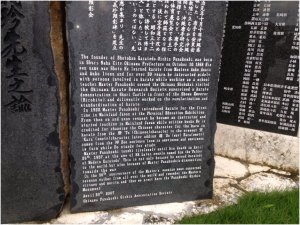
The memorial reads «karate ni sente nashi” (Japanese for “there is no first attack in Karate”). 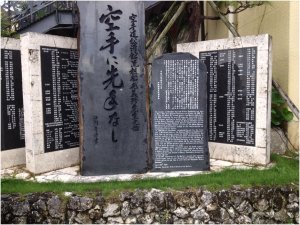
Funakoshi Memorial EJECUTIVOS WKF VISITARON EL MONUMENTO DE Funakoshi en Okinawa
Sr. Antonio Espinos, presidente de la WKF, acompañado por ejecutivos de la WKF, visitó el monumento de Gichin Funakoshi en Okinawa con motivo de la primera WKF Premier League en Okinawa la semana pasada.
El monumento fue construido cerca del Budokan, en el parque donde Funakoshi solía meditar y entrenar con frecuencia. Funakoshi era un maestro en Okinawa, sino también una persona culta y calígrafo. Él aprendió karate en la instigación de los dos maestros Anko Asato y Anko Itosu y que fue él quien desarrolló el estilo Shotokan, que fue nombrado después de que su nombre de pluma «Shoto» (nombre japonés de pinos) y «Kan» (casa). La leyenda dice que su maestro de caligrafía le dio este nombre de pluma, ya que le gustaba venir meditar o hacer ejercicio en el parque al lado del Budokan, donde había un montón de árboles de pino.
Funakoshi se llama el fundador del karate moderno no porque él inventó una técnica diferente, sino porque había dado sus cartas de nobleza al «hacer» de karate, una forma de practicar karate. También transformó el carácter chino «Para» en el carácter chino «Kara» (vacío), después el (camino) «Do», se añadió.
Fue uno de los primeros en iniciar un camino filosófico a través del campo y se exporta el karate de Okinawa a Japón. Fue ayudado y apoyado en sus esfuerzos por el fundador del judo, Jigoro Kano, quien fue él mismo un calígrafo famoso.
El monumento es el siguiente:
«El fundador de Shotokan Karatedo, Gichin Funakoshi, nació en Shuri, Naha City, Prefectura de Okinawa el 10 de octubre de 1868 Su seudónimo era Shoto. Él aprendió karate de Masters Anko Asato y Anko Itosu y por más de 30 años, él interactuaba ampliamente con las personas implicadas en karate mientras trabajaba como maestro de escuela. maestro Funakoshi inauguró el Okinawa Shubokai, visitó la Sociedad de Investigación de Okinawa Karate, supervisó una demostración de karate en el Castillo de Shuri delante del emperador Showa (Hirohito), y trabajó con diligencia en la popularización y la normalización de karate. en 1922, el Maestro Funakoshi introdujo el karate por primera vez en la isla principal de Japón en la Exposición de Educación Física. Desde entonces y bajo petición, se hizo instructor y comenzó a enseñar en la isla principal de Japón, mientras que escribir libros. le acreditan para cambiar el carácter chino para el «kara» en el karate del carácter «a» (china) hasta el presente «Kara» carácter (vacío), para luego añadir «Do» (camino). Kara (vacío) proviene de la frase Zen «la forma es vacío y el vacío es forma «, mientras que Do significa estudio. Maestro Funakoshi enseñaba incansablemente hasta su muerte en 26 de abril 1957, a la edad de 88 años más tarde, la gente lo llamó el «Padre de Modern Karatedo». Esto no es sólo porque él extendió Karate-do al mundo, sino también por la disposición del Maestro Funakoshi hacia el camino. En el 50 aniversario del Máster de fallecer, las personas interesadas se reúnen de todas partes del mundo y recordar las virtudes y méritos del Maestro, y por lo tanto nos erigen aquí el «monumento Funakoshi Gichin».
20 de abril 2007
Okinawa Funakoshi Gichin Appreciation Society «.WKF EXECUTIVES VISITED THE MEMORIAL OF GICHIN FUNAKOSHI IN OKINAWA
Mr Antonio Espinos, WKF President, accompanied by WKF Executives, visited the Memorial of Gichin Funakoshi in Okinawa on the occasion of the first WKF Premier League in Okinawa last week.
The memorial was built close to the Budokan, in the park where Funakoshi used to meditate and train frequently. Funakoshi was a teacher in Okinawa, but also a cultivated person and calligrapher. He learned karate at the instigation of the two masters Anko Asato and Anko Itosu and it was him who developed the Shotokan style, which was named after his pen name “Shoto” (Japanese name for pines) and “Kan” (home). The legend says that his calligraphy master gave him this pen name since he liked to come meditate or work out in the park next to the Budokan where there were lots of pine trees.
Funakoshi is called the founder of modern karate not because he invented a different technique but because he had given its nobility letters to the “do” of karate, a way to practice karate. He also transformed the Chinese character “To” into the Chinese character “Kara” (empty), later the “Do” (way), was added.
He was one of the first to initiate a philosophical way through the field and exported karate from Okinawa to Japan. He was aided and supported in its efforts by the founder of judo Jigoro Kano, who himself was a renowned calligrapher.
The memorial reads as follows:
«The founder of Shotokan Karatedo, Gichin Funakoshi, was born in Shuri, Naha City, Okinawa Prefecture on October 10, 1868. His pen name was Shoto. He learned karate from Masters Anko Asato and Anko Itosu and for over 30 years, he interacted widely with persons involved in karate while working as a school teacher. Master Funakoshi opened the Okinawa Shubokai, visited the Okinawa Karate Research Society, supervised a karate demonstration in Shuri Castle in front of the Showa Emperor (Hirohito), and diligently worked on the popularisation and standardisation of karate. In 1922, Master Funakoshi introduced karate for the first time in Mainland Japan at the Physical Education Exhibition. From then on and upon request, he became an instructor and started teaching in Mainland Japan while writing books. He is credited for changing the Chinese character for the «kara» in karate from the «To» (Chinese) character to the present «Kara» (empty) character, later adding «Do» (way). Kara (empty) comes from the Zen sentence «form is emptiness and emptiness is form» while Do stands for study. Master Funakoshi taught tirelessly until his death in April 26th, 1957, at the age of 88. Later, people named him the «Father of Modern KarateDo». This is not only because he spread karatedo to the world, but also because of Master Funakoshi’s disposition towards the way. On the 50th anniversary of the Master’s passing away, concerned persons gather from all over the world and remember the Master’s virtues and merits, and thus we erect here the «Funakoshi Gichin monument».
April 20th, 2007
Okinawa Funakoshi Gichin Appreciation Society.»Fuente: WKF
-
KARATE1 PREMIER LEAGUE – ISTANBUL 2014 : Sorteo y horario/ Draws and Schedule
DRAWS/ SORTEO
SCHEDULE/ HORARIO
-
KARATE 1 PREMIER LEAGUE, ISTANBUL : PROGRAMA /PROGRAMME

Este fin de semana Turquía dará la bienvenida a la mejor Karetekas del mundo para el Karate 1 Premier League en Estambul. El evento se llevará a cabo en Asli Cakir Alptekin Sports Hall el 6 y 7 de septiembre. Se espera que 592 Karatekas de 57 países para participar en este prestigioso evento que se celebrará en Estambul para la 4 ª vez.
En este importante evento, que tendrá lugar a menos de 2 meses antes de los Campeonatos del Mundo, todos los hombres y mujeres Karatekas del equipo nacional de Turquía estarán en la tatamis. Muchos otros atletas de élite mundial, como Enes Erkan (Turquía), Amir Mehdizadeh (Irán), Luigi Busa (Italia), Kayo Someya (Japón), así como también estará presente un número de medallistas mundiales.
Por otra parte, el evento promete ser de una calidad muy alta en términos de organización, ya que también será un ensayo para el 50mo Campeonato de Europa de Karate Mayores, que se organizará en la misma ciudad en marzo del próximo año.
This weekend Turkey will welcome the best Karetekas of the world for the Karate 1 Premier League in Istanbul. The event will be held in Asli Cakir Alptekin Sports Hall on 6th and 7th September. 592 Karatekas from 57 countries are expected to participate in this prestigious event to be hosted in Istanbul for the 4th time.
At this major event, taking place less than 2 months before the World Championships, all the male and female Karatekas of the Turkish national team will be on the Tatamis. Many other world top athletes, such as Enes Erkan (Turkey), Amir Mehdizadeh (Iran), Luigi Busa (Italy), Kayo Someya (Japan), and also a number of world medalists will also be present.
Moreover, the event promises to be of a very high quality in terms of organization, as it will also be a rehearsal for the 50th European Senior Karate Championships, which will be organized in the same city in March next year.
Saturday 06.09.2014
09:00 -11.30 Individual Kata (Male-Female) – Elimination & Repechages
11:30 -17:30 Female Kumite (-50kg, -55kg,-61kg) & Male Kumite (-60kg, -67kg, -75kg) – Elimination & Repechages
17:30 Finals Female and Male individual kata
17:45 Medal awards
18:00 -18:15 Finals – Female kumite (-50kg, -55kg,-61kg)
18:20 -18:40 Medal awards
18:40 -19.00 Final – Male kumite (-60kg, -67kg, -75kg)
19:00 -19:20 Medal awardsSunday 07.09.2014
10:00 – 11:00 Female and Male Team Kata Elimination & Repechages
11:00 -14:30 Female Kumite (-68kg, +68kg) & Male Kumite (-84kg, +84kg)
Elimination & Repechages
14:30 -14:40 Finals – Female kumite (-68kg, +68kg)
14:40 -14:50 Medals awards
14:55 -15:10 Finals – Male kumite (-84kg, +84kg)
15:15 -15:25 Medal awards
15:30 -16:00 Finals – Female and Male team kata
16:00 -16:20 Medal awardsA press conference will be organized on Thursday, September 4th, in presence of top world athletes and will be chaired by Esat Delihasan, President of the Turkish Karate Federation.
Fuente: WKF


Debe estar conectado para enviar un comentario.